| 产品编号 | bs-43804P |
| 英文名称 | Recombinant human TNFRSF9/CD137 protein, C-His (HEK293) |
| 中文名称 | 重组人肿瘤坏死因子受体超家族成员9蛋白 |
| 别 名 | TNR9_HUMAN; Tumor necrosis factor receptor superfamily member 9; 4-1BB ligand receptor; CDw137; T-cell antigen 4-1BB homolog; T-cell antigen ILA; ILA; 4-1BB; CD137; MD109; |
| 克 隆 号 | |
| 理论分子量 | 19.2 kDa |
| 性 状 | Liquid |
| 纯 度 | >90% as determined by SDS-PAGE |
| 缓 冲 液 | PBS (pH=7.4) |
| 保存条件 | Stored at -70℃ or -20℃. Avoid repeated freeze/thaw cycles. |
| 注意事项 | This product as supplied is intended for research use only, not for use in human, therapeutic or diagnostic applications. |
| 产品介绍 |
CD137 exists on the cell surface as a monomer with a molecular mass of 30 kDa and as a dimer of 55 kDa. Human and mouse CD137 share 60% amino acid identity. CD137 (4-1BB), a member of the tumour necrosis factor receptor superfamily, is a type I transmembrane glycoprotein expressed on the cell surface of activated splenic T cells and thymocytes. The functions of CD137 in T lymphocytes include regulating activation, proliferation and apoptosis. CD137 and CD28 are costimulatory molecules of T cell activation. Costimulatory molecules are important in initiating anti-tumor immune responses. CD137 plays an important role in regulating T-cell-dependent immune responses. Expression of CD137 correlates negatively with lymphocyte proliferation and positively with the degree of activation-induced cell death caused by mitogen overstimulation. In monocytes, CD137 induces activation, promotes adherence and prolongs survival. SWISS: Q07011 Gene ID: 3604 CD137属于肿瘤坏死因子超家族成员,是可诱导的T细胞共刺激受体,表达于CD4 + 和CD8 + T细胞、活化的自然杀伤细胞(natural killercell,NK)和树突状细胞,CD137可抑制T细胞增殖,诱发细胞凋亡。 |
| 产品图片 |
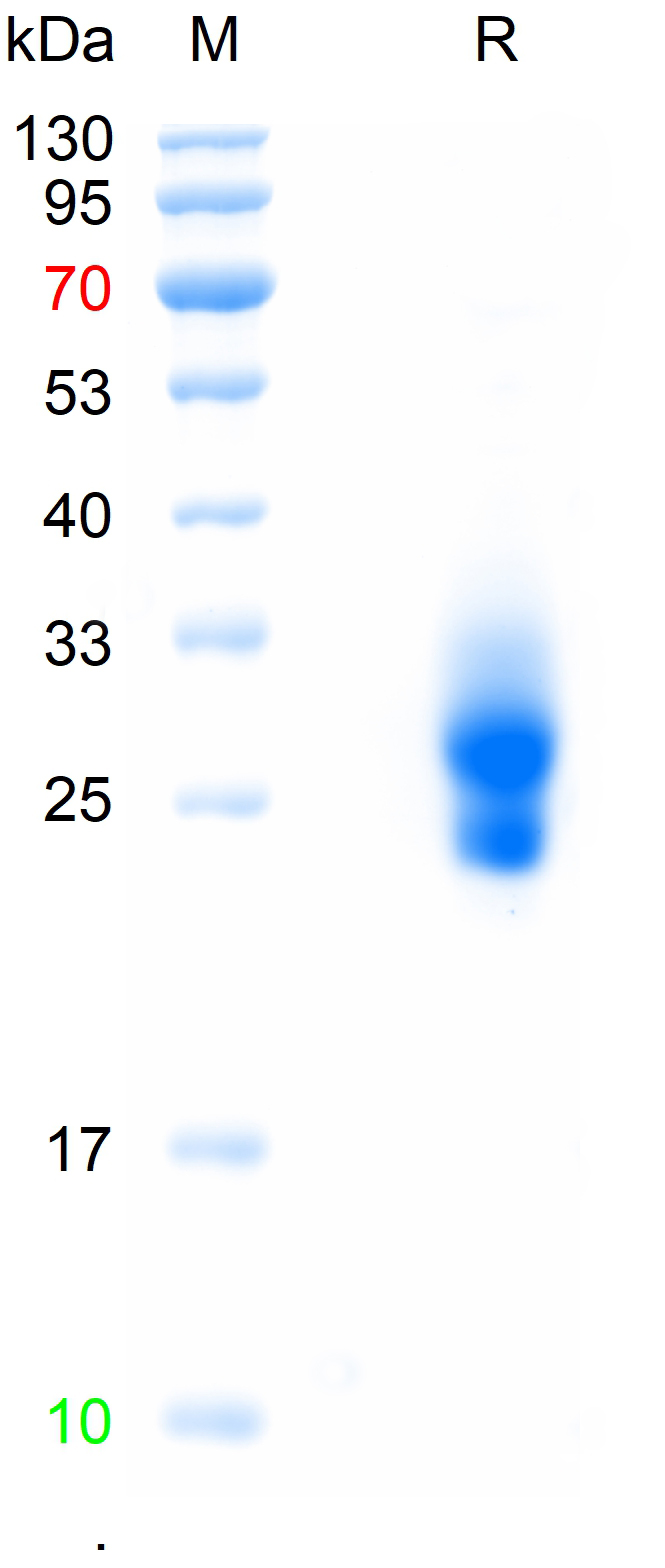
The purity of the protein is greater than 90% as determined by reducing SDS-PAGE.
|
| 1、抗体溶解方法 | |
| 2、抗体修复方式 | |
| 3、常用试剂的配制 | |
| 4、免疫组化操作步骤 | |
| 5、免疫组化问题解答 | |
| 6、Western Blotting 操作步骤 | |
| 7、Western Blotting 问题解答 | |
| 8、关于肽链的设计 | |
| 9、多肽的溶解与保存 | |
| 10、酶标抗体效价测定程序 | |